

London’s Best-Kept Secret
Off market sales were once a rarified subsector of London’s prime market, favoured by high profile owners who didn’t want the world and his wife seeing inside their homes.
Back when Camilla Dell, managing partner of Black Brick, founded the company in 2007, almost the only homes sold without public marketing were those priced at £10m-plus. Over the years, it has grown in popularity, favoured by buyers for whom security or privacy is a concern, and those who wish to test the market by offering their property without showing it on the sale portals. And it is commonplace in London homes priced from £2m.
As a result, access to these secret sales has grown in scale and importance over the past few years.
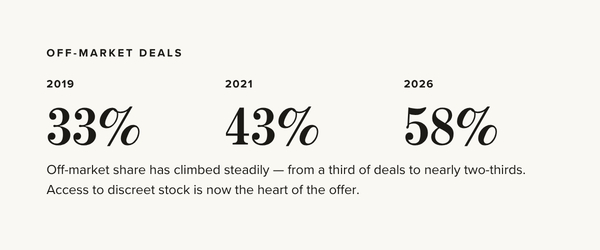
In the first six months of 2019 Black Brick, thanks to its network of contacts across the British capital, sourced a third of the homes it helped clients purchase, off market.
View chart data
| Year | Off-Market Property Acquisitions | Status |
|---|---|---|
| 2019 | 33% | Historical |
| 2021 | 43% | Historical |
| 2026 | 58% | Projected |
This chart illustrates the percentage of off-market property acquisitions in London. The proportion increased from 33% in 2019 to 43% in 2021 and is projected to reach 58% by 2026.
And this figure has gone up and up. In the same period of 2021, more than four in ten of our deals were on off market properties. So far this year, almost six out of ten of the homes we have bought were off market, and that rises to almost three-quarters of those priced at £3m or more.
Tom Kain, a partner at Black Brick, said that an off market sale is favoured by owners when prices are flat or falling. “In a market where sellers are unsure of what price they are going to get, they prefer not to leave a digital footprint if they have to cut their asking price,” he said.
Unlocking access to homes being sold off market requires the support of a well-connected buying agent. “Across the Black Brick team, we have got more than 100 years of experience and over that time, we have built up really strong, valuable contacts with selling agents,” explained Dell. “They also know we represent some of the best buyers in the market – you wouldn’t engage a buying agent unless you were serious about buying. Our buyers are much more credible than someone they don’t know just ringing up and asking about houses.”
This network of contacts extends to lawyers, wealth advisors, banks, and accountants, all of whom come to Black Brick if one of their clients has a great property to sell. And we also take the initiative, using our encyclopaedic knowledge of London’s best streets to directly contact owners if we believe their home would suit one of our clients. This is an approach which regularly bears fruit.
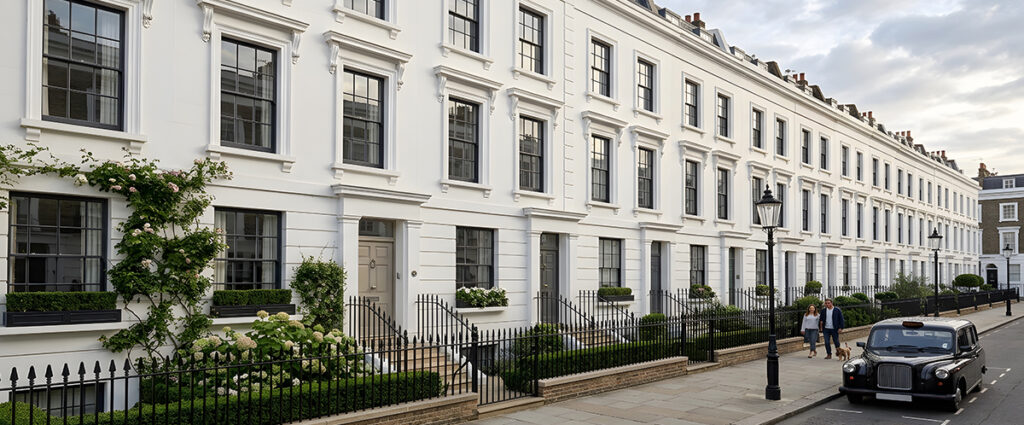
A Space Odyssey
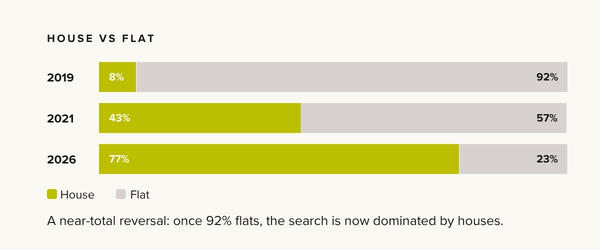
The pandemic-fuelled fashion for houses over flats shows absolutely no sign of slowing down in 2026. So far this year, 77 per cent of our clients have purchased houses. This is a complete reversal of fortune since the same period in 2019, when 92 per cent of our buyers were after an apartment and an even more resounding vote for houses than we saw back in 2021, in the early days of the race for space. Back then, 43 per cent of the homes we secured were houses and 57 per cent flats.
View chart data
| Year | Houses | Flats | Status |
|---|---|---|---|
| 2019 | 8% | 92% | Historical |
| 2021 | 43% | 57% | Historical |
| 2026 | 77% | 23% | Projected |
This chart illustrates the shift in prime property acquisitions in London between houses and flats. In 2019, houses accounted for 8% of acquisitions compared with 92% for flats. By 2021, the market had shifted to 43% houses and 57% flats. By 2026, houses are projected to represent 77% of prime property acquisitions, while flats are expected to account for 23%.
The enthusiasm for whole houses is because the market today is very needs based, said Kain. “Buyers are people with families who want to upsize or buy a first home, and they need somewhere to live regardless of the state of the market,” he said.
“Flats are bought by more discretionary buyers, they are almost always a second or third home, and if people think it is not a good time to buy, they will wait.”
It is also worth pointing out that flats have had a bad press of late, from the fire safety scandal which has emerged in the wake of the Grenfell Tower disaster, to the iniquities of the leasehold system, to rising service charges.
Another issue is Stamp Duty – the buying tax levied by the Government. “Stamp Duty is so high that a lot of our first time buyer clients have missed out the early rungs of the property ladder altogether, saved up for longer, and go straight into a home they can live in for ten or 15 years – and that is usually a house,” said Dell.
View chart data
| Year | Owner-Occupier | Investor / Rental | Status |
|---|---|---|---|
| 2019 | 67% | 33% Investor | Historical |
| 2021 | 100% | 0% Investor | Historical |
| 2026 | 92% | 8% Rental | Projected |
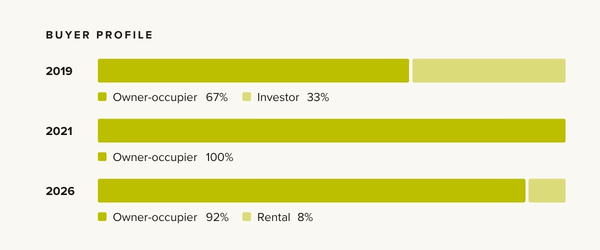
This chart illustrates the changing buyer profile within London’s prime property market. In 2019, owner-occupiers represented 67% of buyers while investors accounted for 33%. By 2021, all recorded acquisitions were made by owner-occupiers. By 2026, owner-occupiers are projected to represent 92% of buyers, with rental-focused purchasers accounting for the remaining 8%.
Andy Burnham, front runner in the race to become Britain’s next Prime Minister, is known to support Stamp Duty reform, something which Black Brick, is all in favour of. “Stamp Duty is so high that it stops people moving and is a tax on mobility,” said Dell in a recent interview with The Times.
Burnham is known to support an alternative system where, rather than paying Stamp Duty and Council Tax, homeowners will pay a single tax based on the value of their property – 0.48 per cent per year, which works out at £4,800 per £1m.
Critics have pointed out that the idea penalises London, where homes are worth considerably more than elsewhere in the country, and is unfair on new owners who have only just paid out for Stamp Duty.
Dell’s feeling is that since the plan requires an accurate, annual valuation of every home in the UK it is unlikely to be rolled out, and certainly not before the next General Election which must be held by August 2029 at the latest. “I think it will just be too difficult to introduce,” she said.
Although Burnham’s property intentions won’t be known for some weeks or months – depending on the speed of the leadership process – other market reforms (which will be somewhat easier to introduce) have also been unveiled.
Preliminary sales packs, giving vital property information including a condition survey upfront earlier binding agreements, and a faster, digitalised system executed by regulated estate agents could all speed up the UK’s notoriously slow buying system and reduce the number of deals which fall through.
This may well assist the mainstream market although Black Brick already handles all due diligence for its clients, works with trusted professionals on all aspects of a sale, and has a fall-through rate of almost zero.

Village People
Black Brick has spread its net wide over London so far this year, buying property from Hampstead in deepest north London, all the way down to Dulwich in the south east.
The postcodes we have helped buyers purchase in are diverse, and each has its own special appeal. But it is clear that in 2026 leafy urban villages – including riverside Richmond and Battersea, elegant St John’s Wood, and buzzy Chiswick – are in especially high demand as buyers look beyond Zone 1 postcodes for a property.
Our sales in these suburban hotspots so far this year comfortably outnumber the deals we have helped strike in Belgravia, Chelsea, and other parts of prime central London.
Things were very different in 2019. Buyers were highly focussed on the West End with almost half of our properties in the prime swathe of central London just east of Hyde Park: notably Mayfair, Marylebone, Belgravia, and Covent Garden. In the same period suburbs accounted for just 17 per cent of our sales.
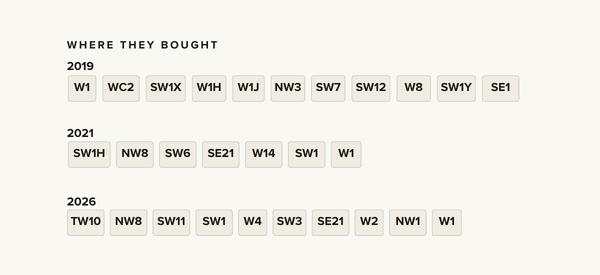
This change in focus is partly explained by buyers’ greater desire for houses, which are in much greater supply out of PCL, and by the dominance of family buyers who tend to want more space.
Black Brick recently assisted a young family who dreamed of upsizing from a period flat to a freehold period house with a garden in south east London’s fashionable Dulwich, a location prized for its village vibes, green space, and fantastic range of schools.
Competition in this neighbourhood can be fierce, but Black Brick has a decades-long relationship with local agents and was invited to view a redbrick family house on a peaceful street before it formally went on the market.
The 1,865 sq. ft house ticked all our clients boxes so, armed with recent comparable sales data, we began negotiations. We were able to shave £50,000 off the asking price and secure the property for £1.95m, or £1,045 per sq. ft.
We then helped our clients navigate a particularly complex purchase process, which involved liaising with lawyers and lenders. They hoped to upgrade the property post-purchase, and so we introduced them to specialists, including architects, contractors, and surveyors so that they could buy the house confident that their plans could be achieved.
Beyond the desire for spacious houses, many of our buyers also want to live in settled, friendly communities where they and their children can make friends and build networks. The suburbs offer this opportunity, along with good high streets and great schools.
“A lot of our clients tell us they don’t want to live like a tourist in London, they want a community,” said Kain.

The Art Of Negotiation
In a buyers’ market, sensible vendors need to be flexible on price, which means that deals can certainly be done.
The exception to this rule is if a vendor is lucky enough to own a property which is very rare and very special – because there are never enough of these truly best in class homes to go around.
Since these are the kind of homes Black Brick routinely secures for its clients, any attempt at reducing the asking price must be done with a great deal of tact and needs to be based on concrete evidence about similar sales nearby.
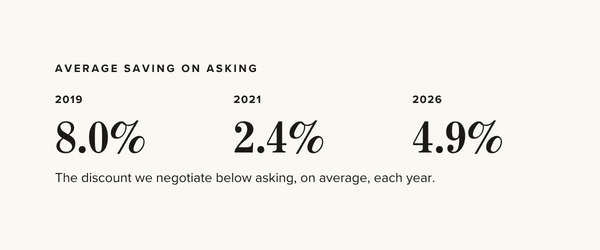
And so far this year, Black Brick has managed to save its clients an average five per cent off asking price.
View chart data
| Year | Average Saving on Asking Price | Status |
|---|---|---|
| 2019 | 8% | Historical |
| 2021 | 2.4% | Historical |
| 2026 | 4.9% | Projected |
This chart illustrates the average saving achieved against the asking price for prime residential property in Prime Central London (PCL). Buyers secured an average discount of 8% in 2019, reducing to 2.4% in 2021 as market competition increased. By 2026, the average saving is projected to be 4.9%, reflecting a more balanced negotiating environment.
The level of discount achievable is generally governed by two factors; the wider state of the market as well as the circumstances of the owner. A vendor who is only testing the market is less likely to be amenable to an offer than one who needs to sell within a set timeframe.
The advantage of using a buying agent for this kind of negotiation is threefold.
Selling agents, who work for vendors, may not be motivated to be completely transparent to prospective buyers about what other, similar properties have sold for in recent months. Black Brick will fill in these gaps, so its buyers understand the context.
We also research the vendor’s circumstances, so we can react accordingly to strike the most advantageous deal possible without losing a sale.
And having a third party to have these sometimes difficult conversations can make the whole process calmer and more effective. “Selling a house is one of the most emotive transactions you can be involved in,” said Kain. “It affects people’s family and their well being and that can make it difficult if you are personally invested.”

Buyer Demographics
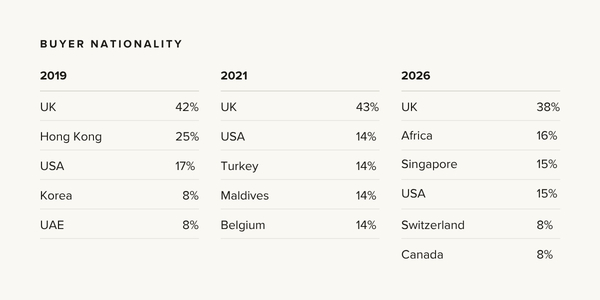
British buyers remain the backbone of the London market, making up around four out of ten of Black Brick’s client list in the first half of 2019, 2021, and this year too.
View chart data
| Year | Buyer Location | Percentage | Status |
|---|---|---|---|
| 2019 | UK | 42% | Historical |
| Hong Kong | 25% | Historical | |
| USA | 17% | Historical | |
| Korea | 8% | Historical | |
| UAE | 8% | Historical | |
| 2021 | UK | 43% | Historical |
| Belgium | 14% | Historical | |
| USA | 14% | Historical | |
| Maldives | 14% | Historical | |
| Turkey | 14% | Historical | |
| 2026 | UK | 38% | Projected |
| Africa | 16% | Projected | |
| USA | 15% | Projected | |
| Singapore | 15% | Projected | |
| Switzerland | 8% | Projected | |
| Canada | 8% | Projected |
This chart illustrates the changing international buyer demographics for Black Brick London property purchases. In 2019, UK buyers represented the largest group at 42%, followed by Hong Kong buyers at 25% and USA buyers at 17%. By 2021, UK buyers remained the largest group at 43%, with Belgium, USA, Maldives and Turkey each representing 14%. By 2026, UK buyers are projected to account for 38% of purchases, followed by Africa at 16%, USA and Singapore at 15% each, with Switzerland and Canada each accounting for 8%.
Beyond domestic buyers, London clearly holds a strong sway over a very wide range of international buyers. This year alone we have sold to buyers everywhere from Singapore to Switzerland, and North America to Nigeria.
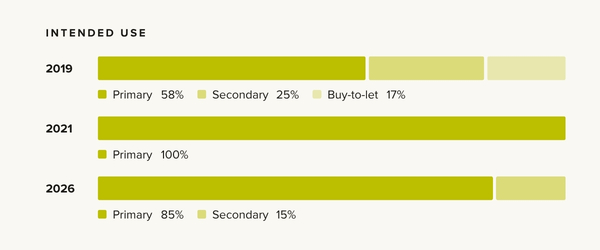
What has changed over the past seven years, is purpose. Back in 2019, a third of the homes we sourced for our clients were investment properties. But major changes in the rental landscape have shrunk this sector and refocused the market on owner occupiers. Every home we bought in the first half of 2021 was for an owner occupier, and so far this year, 92 per cent are also private homes – not rental investments.
View chart data
| Year | Primary Residence | Secondary Residence | Buy-to-Let (BTL) | Status |
|---|---|---|---|---|
| 2019 | 58% | 25% | 17% | Historical |
| 2021 | 100% | 0% | 0% | Historical |
| 2026 | 85% | 15% | 0% | Projected |
This chart illustrates the intended use of prime property purchases in London. In 2019, 58% of purchases were for a primary residence, 25% for a secondary residence, and 17% for buy-to-let investment. By 2021, all recorded purchases were for primary residences. By 2026, primary residences are projected to account for 85% of purchases, with the remaining 15% intended as secondary residences and no significant buy-to-let activity.
Dell believes this change is down to a whole series of changes made to Britain’s rental sector – from increased Stamp Duty for investor-buyers who already own their own property, to taking away landlords’ ability to write their mortgage interest payments off to tax. “Being a buy to let landlord is far less attractive than it was, and it is no longer part of people’s retirement plans in the way that it once was,” she said.
While average house prices have not increased in London since 2019, and in some areas they have fallen, our owner occupier buyers have increased their budgets this year – yet another result of preference for houses over flats.
View chart data
| Year | Cash Purchases | Financed Purchases | Status |
|---|---|---|---|
| 2019 | 37.5% | 62.5% | Historical |
| 2021 | 57% | 43% | Historical |
| 2026 | 46% | 54% | Projected |
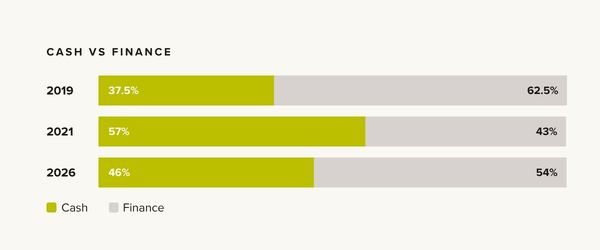
This chart illustrates how prime property purchases in London have been financed over time. In 2019, 37.5% of acquisitions were completed with cash while 62.5% used mortgage or other finance. By 2021, cash purchases had increased to 57%, reflecting stronger cash buyer activity. By 2026, cash purchases are projected to account for 46% of transactions, with financed purchases representing 54% of the market.
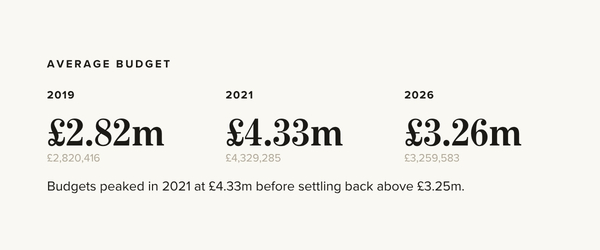
So far this year, our buyers have spent an average £3.3m on their new London home, using a fairly straight mix of finance and cash. In 2021, during the brief post-pandemic uptick in the market, they spent an average £4.3m, and buyers using cash (57 per cent) outnumbered those relying on mortgage finance (43 per cent).
View chart data
| Year | Average Property Purchase Budget | Status |
|---|---|---|
| 2019 | £2.82 million | Historical |
| 2021 | £4.33 million | Historical |
| 2026 | £3.26 million | Projected |
This chart illustrates the average budget for Prime Central London (PCL) property purchases over time. The average purchase budget increased from £2.82 million in 2019 to £4.33 million in 2021. By 2026, the average budget is projected to be £3.26 million, reflecting a return towards more typical prime property purchase levels.
In 2019, when anxieties over Brexit were dominating buyers’ thinking, the average budget was a relatively modest £2.8m, and with interest rates low, 62 per cent of our buyers borrowed to secure their property.

Black Brick News
Black Brick’s trophy cabinet is already full to overflowing but we will have to find a bit more space.
Tom Kain, who has acquired more than £400m-worth of property for clients since joining us in 2013 has been named buying agent of the year in the annual property awards run by prime London analyst LonRes to honour the best-performing agents of the past year.
Tom’s win was based on his “exceptional” sales figures during 2025 and 2026 which were higher – by transaction value and volume – than any other buying agent in London.
His view is that in a market with a high volume of stock to choose from. and where prices are volatile, more and more buyers are looking to buying agents to help them on their journey.
Tom sees his role as a “matchmaker”, getting under the skin of clients to understand what they really want and need, and then harnessing his extensive network of contacts to find the perfect home, often accessing properties being sold off market or getting in before they even hit the market.
“My skill is being able to matchmake the right people with the right properties,” he said. “I am quite good at understanding what kind of property buyers really want, even if they can’t quite put their finger on it themselves. I am very client focussed, and sometimes I can open up a type of property or an area that they had not actually considered before.”