A buying agent’s guide to living in Notting Hill: whether it is posh and expensive, how it got that way, what homes cost and which streets buyers want most.
The short answer Yes, Notting Hill is posh and expensive. It is one of the original Prime Central London neighbourhoods, with grand crescents, private garden squares and houses on the best squares priced at £8 million plus. It has not always been that way: after the Second World War it was known for cheap rentals, and gentrification only began in the 1980s.
From grimy industrial backwater to cosmopolitan melting pot, Notting Hill is an area with a talent for reinvention. Today it is the fun side of Prime Central London: busier than Holland Park or Belgravia, with house prices to match its reputation and schools that make it a hit with families.
Key Takeaways
Notting Hill is prime London with a real sense of community, and the best homes here are still some of the hardest in London to buy.
£1,161
Average price per square foot across Notting Hill and Holland Park (LonRes, 2026)
£4.3m
Average price of a prime Notting Hill property, according to Savills
£8m+
Price of a home on one of Notting Hill’s garden squares
- Posh, but not quiet. Portobello Road, its restaurants and bars, and Carnival every August make it livelier than most of prime London.
- Prices have softened. LonRes puts prices across Notting Hill and Holland Park down 4.7% over the past year and up 1.5% over five years.
- Garden squares lead the market. Homes with a key to a private communal garden rarely come up, and are often sold off market.
- It works for families. Thomas Jones and Colville are both “outstanding” state primaries, and Chepstow House is an excellent fee-paying school.
Is Notting Hill posh?
Yes. Notting Hill, in W11, is one of the original Prime Central London neighbourhoods around Hyde Park, alongside Kensington, Knightsbridge, Belgravia and Mayfair.
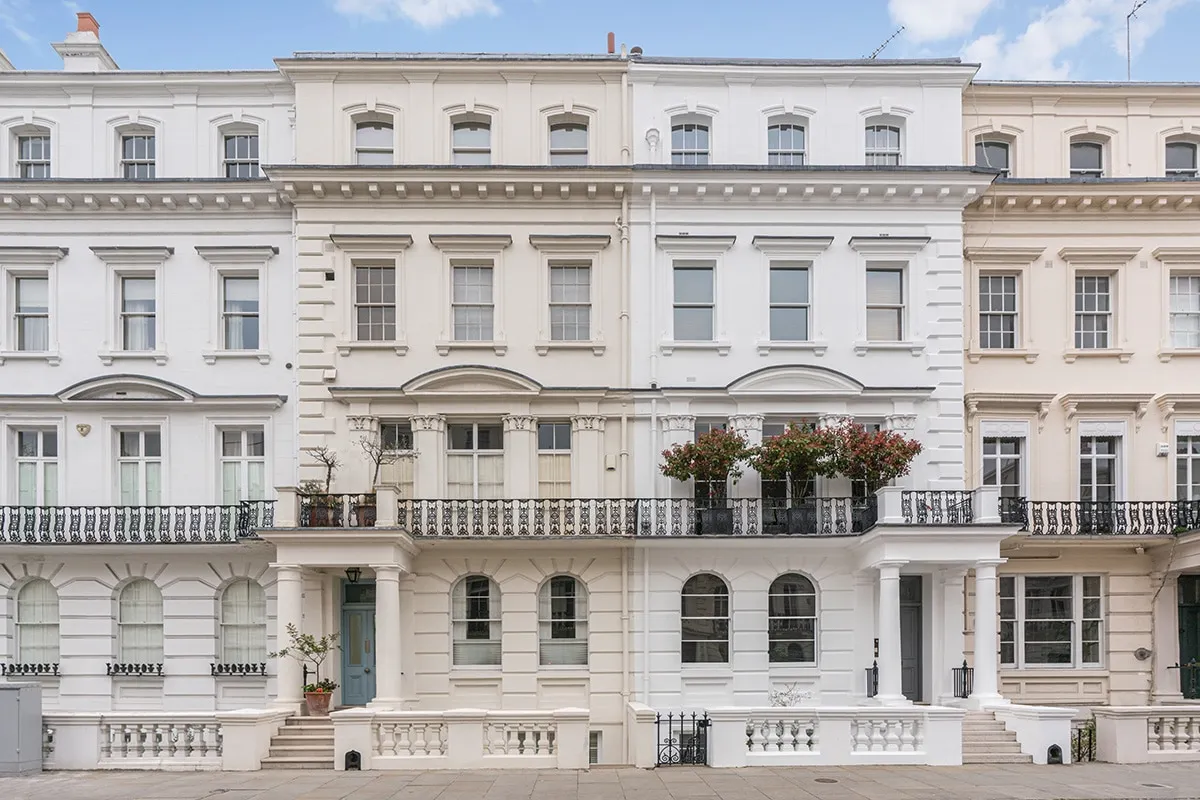
Home buyers love it for its grand crescents, the pretty garden squares made world-famous by the 1999 rom com starring Julia Roberts and Hugh Grant, and its streets of pastel-painted cottages. The most sought-after houses come with a key to a private communal garden, such as the seven acres of Ladbroke Square.
It is posh with a bohemian edge. Its restaurants range from the three Michelin star Core by Clare Smyth to small local cafés, it is one of London’s best places for star spotting, and its buyers include a fairly equal mix of British and international families. American buyers are particularly active here.
Is Notting Hill expensive to live in?
Yes, although there is a wide range. According to research from Savills you can buy a Notting Hill address from £550,000 for a one-bedroom apartment, but the average price for prime properties in Notting Hill is £4.3 million. Best-in-class homes such as those in Artesian Village, a sought-after enclave north of Westbourne Grove, fetch in the region of £3.5 million to £7 million. Homes on garden squares are priced at £8 million plus.
LonRes puts the average price per square foot across Notting Hill and Holland Park at £1,161, down 4.7% over the past year and up 1.5% over five years. Over the 25 years after the film Notting Hill came out, house prices rose by 264.3 per cent.
Our own Notting Hill purchases show the range:
- Pembridge Crescent: a two-bedroom, second floor apartment secured for £1.795m, despite another buyer trying to outbid us.
- Westbourne Park Villas: a £3.25m family house that was being quietly sold off market.
- Kensington Park Gardens: a £21.5m house with a key to Ladbroke Square, which has since drawn unsolicited offers of more than £30m.
When did Notting Hill become posh? A brief history
When Victorian London was expanding Notting Hill was its engine room – its kiln workshops were kept busy making the bricks, pottery and tiles, from the heavy local clay soil, needed to build its new suburbs.
In the early 19th century the Ladbroke family, Notting Hill’s major landowner, began laying out new streets and squares and building upscale family homes, which often came with access to large, private but also communal gardens.
In 1837 entrepreneur James Whyte decided that what west London really needed was a racecourse. He leased 140 acres of land from the Ladbroke Estate and laid out a track. Unfortunately the venture was not a hit and by 1842 the course was closed, although the shape of the course can still be traced in Notting Hill’s series of crescents.
After the Second World War Notting Hill’s fortunes fell. Families struggled to employ staff after the war and nobody wanted large townhouses any more. Many homes were split up into flats, and the area became known for its cheap rentals and boarding houses.
Notting Hill in this era was a melting pot of emigrés to London – and those from the Caribbean organised the first Notting Hill Carnival in 1966.
Gentrification began in the 1980s as buyers priced out of other parts of Prime Central London rediscovered Notting Hill. At the same time a disproportionate number of great restaurants, cafés and bars began popping up. Notting Hill’s reputation as the fun side of Prime Central London, with a real sense of community and a character all its own, was born.
Is Notting Hill a nice place to live?
A destination in its own right, Notting Hill is a very different proposition to elegant, but primarily residential, districts like Holland Park or Belgravia.
If you crave the quiet life it might not be right for you, but Notting Hill is perfect for those who want to live right in the thick of things – particularly in August when the steel drums of the Notting Hill Carnival begin to beat.
It has great bars and restaurants on every street corner, catering to every taste – from Core by Clare Smyth to the Secret Sandwich Shop, where you can pick up beautifully presented Japanese sandwiches.
Although its reputation is very much linked to its nightlife and shopping, Notting Hill is also surprisingly family friendly. Its lovely large houses have roomy back gardens, and there are fantastic schools for all ages. Thomas Jones and Colville Primary are both “outstanding” state primaries, and Chepstow House is an excellent fee-paying school. For older pupils, Kensington Aldridge Academy and the Cardinal Vaughan Memorial School also get top marks from the schools’ watchdog, and St Paul’s and Godolphin and Latymer are a comfortable school run to the west.
Notting Hill lifestyle highlights
A street market guarantees to give a neighbourhood a bit of buzz, and Portobello Road is one of London’s biggest and best. Trawl for antique treasures or vintage and modern fashion, stock up on fruit and flowers, and dine on street food, in one of the most vibrant street scenes the British capital has to offer. If Portobello feels too hectic, then locals head over to the more peaceful Golborne Road, with its antique stores and stalls, and great local cafés.
Built in 1911, the Electric Cinema is one of London’s oldest movie theatres. Now owned by the Soho House Group, its screening room is super comfortable, and there is also a restaurant and private members’ club on site.
The Museum of Brands is one of London’s smallest and most eccentric museums, devoted to advertising from the Victorian era to today.
A culture-rich social calendar
Over August’s bank holiday weekend Notting Hill erupts with 72 hours of music, colour and fun. Around three million people attend the Notting Hill Carnival – Europe’s largest street festival – to celebrate Caribbean arts, heritage and culture.
The annual Portobello Film Festival is a chance to see an incredible range of work by new film makers. It premieres more than 700 films each year.
Leighton House is a museum and art gallery housed in the former home of Victorian painter Frederic Leighton. Join the Friends of Leighton House and expect exhibition and concert previews, plus invitations to its annual dinner and summer garden party.
The best streets in Notting Hill
Within the hierarchy of top streets in Notting Hill, homes on garden squares or with access to private gardens lead the way.
Black Brick were engaged by American clients who were returning to live in London and wanted to come “home” to Notting Hill. They already knew the area well enough to have a shortlist of specific streets, and they particularly wanted to live somewhere with access to a communal garden.
This kind of property doesn’t come onto the market very often, and when one does demand is high. We knew our best option would be to find a house before it came onto the market, and were made aware of a great house on Kensington Park Gardens which came with a key to the seven acres of Ladbroke Square.
To secure the property we advised our clients to snap it up at the £21.5m asking price. Following a full refurbishment we have received unsolicited offers for the house – even though it is not for sale – in excess of £30m. Read the Kensington Park Gardens case study.
Notting Hill townhouses lend themselves well to being converted into apartments. A couple who had relocated to London for work engaged Black Brick to find them a two-bedroom property. Our choice for them was a second floor apartment on the brilliantly located Pembridge Crescent. Even with another buyer attempting to outbid us we were able to secure the property for £1.795m. Read the Pembridge Crescent case study.
Finding a Notting Hill property with a buying agent
If you want a home on Ladbroke Square, Kensington Park Road, Lansdowne Road, Clarendon Road or one of Notting Hill’s iconic crescents, you are going to face competition from other buyers. Owners tend to stay put in these sought-after streets long term, and that means that homes rarely come onto the market. When they do, they are often sold discreetly, off market, which means that you will need insider information just to know what your options are.
Black Brick’s enviable contacts mean that we can find unfindable properties on your behalf, and get you in before other buyers. This is invaluable in a market where best-in-class homes are still breaking price records.
We can also negotiate on your behalf, advise you on prices, and guide you through the buying process from start to finish. Even once you have bought your new home our assistance doesn’t stop. We also help our buyers find the right architects and interior designers to put the finishing touches to their new homes.
Looking for your next luxury property in London? View our full range of Prime Central London area guides, or simply get in touch with your property requirements to open a conversation.
Your Questions Answered
Yes. According to Savills, prime homes in Notting Hill average £4.3 million and houses on its garden squares are priced at £8 million plus. Its buyers are a fairly equal mix of British and international families, and American buyers are particularly active here.
Yes. Notting Hill, in W11, sits in the north-west of Prime Central London. Most property experts count it as one of the original prime central neighbourhoods around Hyde Park, with Kensington, Knightsbridge, Belgravia and Mayfair.
No. The Ladbroke family built it as an upscale suburb in the early 19th century, but after the Second World War many houses were split into flats and the area became known for cheap rentals and boarding houses. Gentrification began in the 1980s, when buyers priced out of other parts of Prime Central London rediscovered it.
According to Savills, a one-bedroom apartment starts from about £550,000 and prime properties average £4.3 million. Homes in Artesian Village fetch around £3.5 million to £7 million, and homes on garden squares are priced at £8 million plus. LonRes puts the average across Notting Hill and Holland Park at £1,161 per square foot.
Yes. Its large houses have roomy back gardens, Thomas Jones and Colville are both “outstanding” state primaries, and Chepstow House is an excellent fee-paying school. Kensington Aldridge Academy and the Cardinal Vaughan Memorial School also get top marks for older pupils.
Homes on garden squares or with access to private communal gardens lead the way. Ladbroke Square, Kensington Park Road, Lansdowne Road, Clarendon Road and the crescents are among the most sought after, and homes there are often sold off market.